
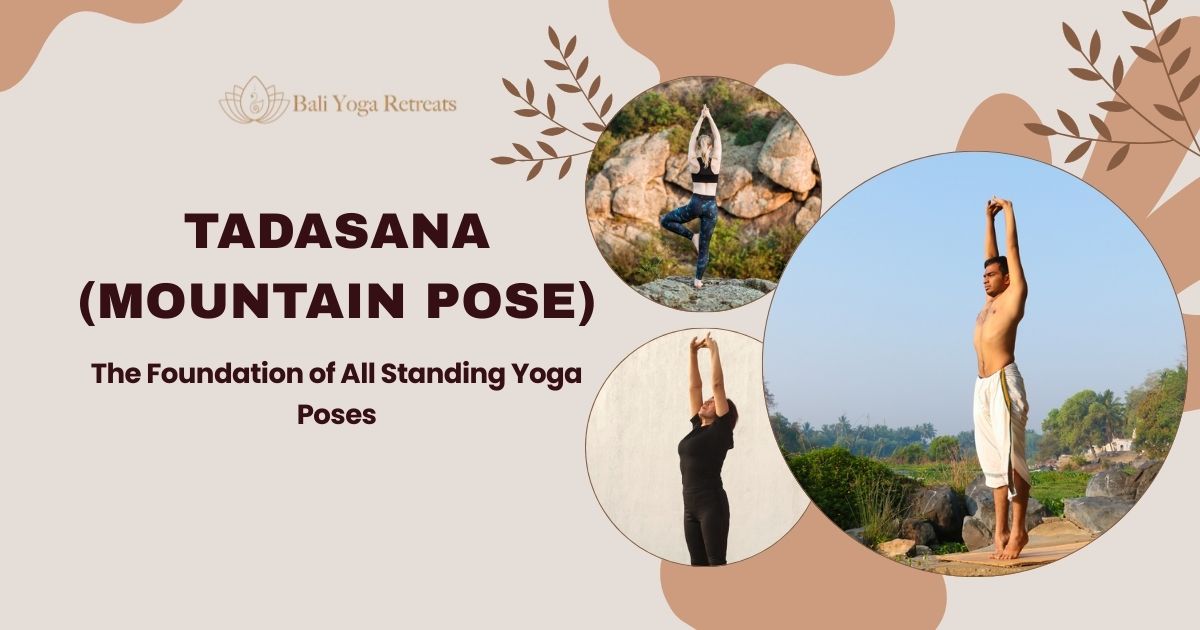
Mountain Pose, or Tadasana, is the most important yoga pose because it teaches the body how to move in space. If you do not pay attention, you might think the person doing yoga is just standing still, but that is not the case. A lot of work is going on inside to keep the position. This pose is the basis for all standing poses because it lines up the bones so that the muscles do not have to work as hard to hold weight. This changes standing from a passive habit into an active and conscious way to deal with gravity.
Most people stand with their shoulders slumped forward or their weight unevenly spread out. These patterns of constant stress can cause pain and injury over time. Tadasana yoga makes you very aware of your feet, spine, and breath, which helps you stand up straight and strong.
This guide has everything you need to know about the mountain pose (tadasana). We will look at the small details of how to stand straight and the benefits of tadasana to help you build a practice that is based on accuracy.
Meaning and Origins of Tadasana (Mountain Pose)
The Sanskrit word “Tadasana” is made up of two words that perfectly describe the pose: “Tada” means “mountain” and “asana” means “pose” or “seat.” When you do the Tadasana mountain pose, you become like a tall mountain by becoming still, stable, and deeply connected to the ground below you. No matter what the weather is like, a mountain will always be tall. When things are always changing, this pose helps the yogi stay calm and focused.
Some styles of yoga call this pose Samasthiti, which means “equal standing.” Even though the names are often used to mean the same thing, Samasthiti means “a call to attention” or “a state of readiness.” The meaning of this connects the person doing it to the sky above and the ground below. The feet are like the bottom of a mountain, and the top of the head goes up into the sky. This two-part movement makes us feel taller and bigger, which helps us fight against the pull of gravity that we feel all day. Because of this, mountain pose yoga helps us get back to our natural height and dignity.
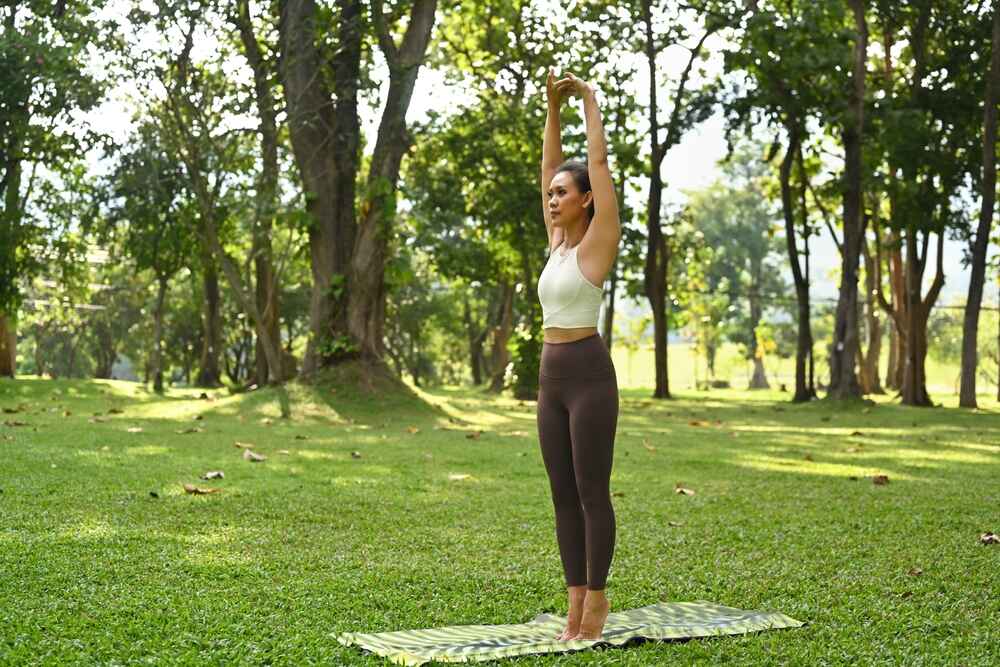
How Mountain Pose Can Help You Stand Up Straight and Stay Balanced
Tadasana is important because it puts your body in a neutral position. Finding your balance in harder poses will be hard if you can not stand on two feet. In every standing pose, the legs and hips are used in the same way they are in Tadasana. You can use what you learn here right away in warrior poses and balancing poses. This pose teaches you how to stack your bones and find your center of gravity so that your muscles do not have to work as hard.
A lot of people do not know what neutral alignment feels like because they spend too much time sitting in chairs and looking at screens. This makes their heads move forward, and their hips get tighter. Tadasana puts your bones back in the right place, which helps your body get back to normal. At first, it takes work to stay in this shape, but over time, it becomes a nice place to relax and check in with yourself. You start every practice here and come back here after standing sequences. This is where you can take a break and get back on track.
How to Practice Mountain Pose (Tadasana) Step by Step
We will now break down the mountain pose yoga into steps so you can learn how to perform it from the ground up. The right way to do Tadasana.
1. To Set Up the Base
Stand at the front of your mat and bring your feet together so that your big toes touch. To make sure that the outside edges of your feet are parallel, keep your heels a little apart. If you can not keep your balance or your thighs rub together in a way that hurts, you should move your feet apart so that they are at least as wide as your hips. This will give you a wider and more stable base of support. You should lift your toes off the mat and spread them wide before putting them back down. This makes your base wider and helps you stay on the floor.
2. Maintain Posture
Push the four corners of your feet firmly into the floor to engage your legs. This is the base of the big toe, the base of the little toe, the inside heel, and the outside heel. Keep your knees up as you push down through these points to protect the knee joint and keep it from going too far. This will make your thigh muscles stronger. To make your sitting bones wider, you should turn your inner thighs back a little. This gives the lower back more room and helps keep the pelvis stable.
3. Align the Pelvis
Your pelvis is the most important part of your posture, so make sure it is neutral, which means it is not leaning forward or backward. To stretch your lower back without tucking it under too much, point your tailbone down toward your heels. At the same time, pull your lower belly in and up to help your lower back. This action gives your internal organs room and keeps your lower back from hurting when you stand for a long time.
4. Lengthen the Spine
Imagine that a string is pulling you up from the top of your head to the ceiling. Lift your breastbone, but relax your front ribs so they do not stick out and mess up the connection between your core and your body. This keeps the core moving and the back straight, which lets energy flow freely up and down the spine.
5. Put Your Arms and Shoulders in the Right Place
To relax the upper back muscles and open the chest, roll your shoulders up toward your ears and then back and down. Let your arms hang by your sides and turn your palms so they are facing forward. This will help keep your collarbones wide and your shoulders from rolling forward. To keep your arms from getting limp, send energy through your fingertips as if you were reaching for the ground.
6. Center the Head
Keep your head directly above your pelvis so that your chin stays level with the floor and your jaw stays relaxed. If you feel safe, close your eyes or soften your gaze and look at something in front of you. This alignment takes the heavy work of holding up the head off of the neck muscles and lets the neck keep its natural curve.
Detailed Anatomy and Alignment
To really understand tadasana (mountain pose), we need to look more closely at how the body works.
The human foot has three arches: the inner arch, the outer arch, and the arch across the ball of the foot. You need to activate all three arches in Tadasana to stop your knees from collapsing inward and your hips from rotating inward. This makes the whole chain unstable. Imagine lifting the inner ankles off the ground so that the lift goes up the inner legs and pushes against gravity.
The position of the pelvis determines the shape of the spine. To find a neutral pelvis, you need to balance the strength of your abs with the flexibility of your hip muscles. When the pelvis tilts forward, the lower back bends too much, which puts pressure on the lower back bones. When the pelvis tilts back, the lower back flattens, and the head often moves forward. You need to find the sweet spot where the bowl of the pelvis is level in order to support the natural curves of the spine.
The spine has natural curves that help it deal with shock. The goal of mountain pose yoga is not to flatten these curves, but to lengthen them. You stretch your neck and lower back to make space between the bones. This lets signals from the brain to the rest of the body move around easily. This relieves stress on the spine discs and keeps them in good shape.
Health Benefits of Mountain Pose (Tadasana)
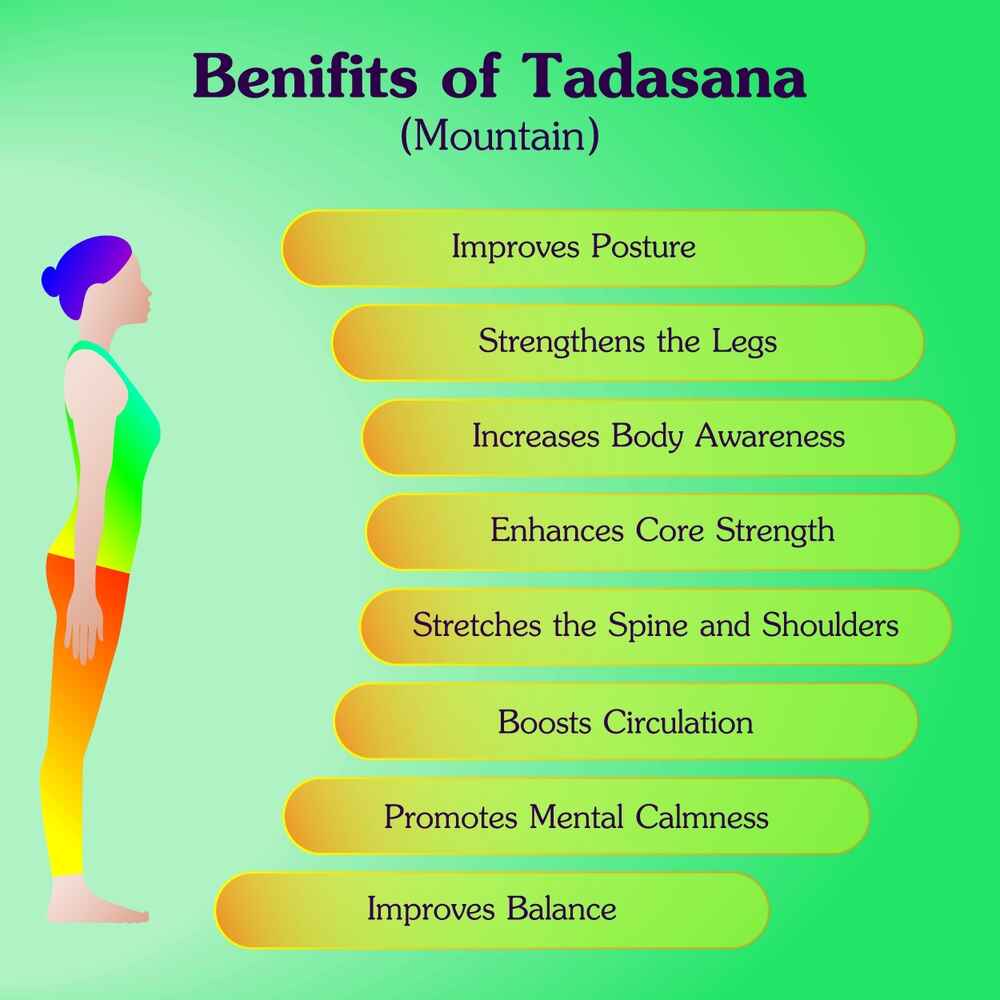
Tadasana is good for your mind and body, and it has a lot of other benefits besides helping you stand up straight.
1. Physical Corrections and Strength Tadasana
This exercise teaches your body how to stand up straight again, which helps fix the problems that come from sitting at a desk or looking at a screen. It makes the muscles in the feet stronger, which can help with flat feet and the pain that comes with sore feet. Moving your legs around strengthens your thigh and leg muscles while keeping your joints in the right place to keep your knees and hips from getting worn out. It also helps with back and leg pain by making more room in the lower back and relaxing the deep hip muscle, which can put pressure on the nerve.
2. Mental Awareness and Focus
It can be harder to stand still than to move because standing still makes you think about how you feel. Tadasana yoga helps you become more aware of your body and how it moves, so you can tell when it moves or sways. To fix these little movements, you need to really focus. This focus calms the mind and gets the nervous system ready for meditation.
When you slouch, your breathing muscles and lungs get squished together, making it harder to breathe. This is how your chest and shoulders are lined up in mountain pose. By rolling your shoulders back and lifting your breastbone, you can make the chest space bigger and let the breathing muscle drop all the way down. This action makes your lungs bigger and lets in more air. This gives your brain more oxygen, which makes you feel more awake and alert.
Common Mistakes and How to Fix Them
Even people who have been doing yoga for a long time can develop bad habits. To keep your tadasana mountain pose safe, you should be careful not to make these mistakes.
A lot of people do not know this, but they put their weight on the inner edges of their feet, which flattens the arches and puts stress on the knees. To fix this, you need to push down hard on the outer edges of your heels and the base of your little toes. Think about how you can pull energy up from the ground through the center of your foot.
- Locking the knees: People with flexible joints often push their knees back and lock the joint. The tough tissues take the weight of the body instead of the muscles. You should bend your knees a little so you can feel your thigh muscles working. If your kneecaps are loose, your legs are not working hard enough.
- Flaring the Ribs: Students often push their lower ribs forward to try to stand up straight. This separates the core and compresses the middle back. If you want to keep a strong cylinder in your body, knit your front ribs together like you would if you were wearing a corset. This will help keep your chest up, but it will make the ribs that float near your hips softer.
When you text and drive, your head can move in front of your shoulders, which pulls on the head and puts stress on the neck muscles. To fix this, pull your chin back a little bit, as if you were making a double chin. Then, raise your head so that your ears are right above your shoulders.
Modifications and Variations of Tadasana (Mountain Pose)
Anyone can do yoga, so you can change the mountain pose to fit how strong and balanced you are right now.
- Wider Stance for Stability: If you do not feel stable with your feet together, move them apart until they are hip-width apart. This gives you a bigger base of support, which makes it easier to find the right place for your pelvis. This change is great for pregnant women or people with lower back pain who need a more stable base.
- Wall Support: When you do tadasana against a wall, you can feel how your body is feeling right away. This helps you find the exact parts that are out of alignment. You might notice that your head does not touch the wall when your spine is straight if you stand with your heels, tailbone area, and shoulder blades against the wall. This change shows how far the head has moved forward and helps the neck muscles remember how to keep the head in the right place.
- Arm Variations: Your arms should usually be at your sides, but you can stretch your shoulders and make your side body longer by raising them over your head into Upward Salute. You can also put your hands in a prayer position at the heart center. This can help you feel centered and thankful, which is good for both sides of your brain.
- Using a Block: Put a yoga block between your upper thighs and squeeze it to help your legs learn how to work together. This move makes your inner thighs turn back, and your sitting bones spread apart. This makes your pelvis more stable and protects your lower back.
How to Apply Mountain Pose in Daily Activities
You do not need a yoga mat to do this pose. You can do it wherever you are. While you wait in line at the store, make sure your spine is long, and your feet are parallel. Instead of leaning on the sink, lift your arches and use your legs to brush your teeth. When you wash the dishes, keep your head over your shoulders and roll your shoulders back.
Look at your knees, shoulders, and feet. Fixing these little things will help you relax and have a better day. You stop being tired when your bones hold you up, and you stop hurting when your joints are in the right place. You are in the moment, which means you are doing yoga while you go about your daily life.
The Active Side of Tadasana
Yoga teaches that energy moves through the body in certain ways. These channels close up when you have bad posture, like a kink in a hose. Tadasana opens these pathways so that energy can move freely from the earth to the sky. When you feel grounded, you feel safe and stable in your body and in the area around you.
The pose connects to the Root Chakra, which is the energy center at the base of the spine that controls survival and feeling like you belong. This center gets stronger when you stand firmly on your feet, which makes you feel safer in the world. You feel ready to face challenges because you know you have a strong base.
Tadasana as a Change
You do this pose a lot in yoga class, usually after Sun Salutations (Surya Namaskar) and before you stand up. Do not skip the work of this pose or just wait for the next one. Use this time to get back on track instead. Take a deep breath, slow down your heart rate, and see if you lost your balance while you were moving. This pose is like the string that holds the whole practice together. It protects you and keeps you aware as you change shapes.
Read More: Surya Namaskar Yoga: 12 Steps, Mantras, Benefits & How to Practice
Final Thoughts
Tadasana is easy but deep because it is the most important standing pose in yoga. It teaches us how to stand tall and gracefully and how to be in our bodies. We learn to be as strong as a mountain and as soft as a breath to find a balance between work and rest. You can feel the benefits of tadasana right away: you get stronger, stand taller, and feel better. The pose gives you a strong base for a long, healthy life that starts as soon as you get off the mat. It alters your mind and body.
Come to our 200 Hour Yoga Teacher Training Bali if you want to learn these old techniques and get better at what you do. You will learn how to improve your alignment and how powerful Tadasana can be in a beautiful, supportive environment. Start your journey to strength today by learning about the body and how to teach.