

Yoga for Anxiety and Stress: Poses and Practices That Actually Help
Table of Contents
- How Yoga for Anxiety Works in the Body
- What Yoga for Anxiety Can and Can’t Do
- Best Yoga Poses for Stress Relief and Anxiety
- Grounding Standing Poses
- Gentle Seated and Floor Poses
- Restorative Poses
- Poses to Approach Carefully
- A Simple Stress-Reducing Yoga Routine You Can Follow at Home
- Breathing Practices That Calm the Nervous System
- Mindfulness and Meditation Practices That Complement Yoga
- How to Practice Yoga for Anxiety Safely
- Building a Realistic Weekly Practice for Stress Management
- When to Seek Professional Support
- Frequently Asked Questions
- Can yoga actually help with anxiety?
- What is the best yoga pose for anxiety?
- How often should I practice yoga for stress relief?
- Can breathing exercises alone reduce anxiety without the poses?
- Is yoga safe for panic attacks?
- Should beginners with anxiety start with a class or practice alone?
- How long does it take for yoga to help with stress?
Yoga for anxiety can really help calm a racing mind and a nervous system that feels stuck “on“. It works best as extra support, not as a replacement for proper care. The poses on their own are not magic. What helps is the mix of slow breathing, gentle movement, and calm attention, all of which tell your nervous system it is safe to relax. This article looks at yoga poses for stress relief that are worth your time, breathing and meditation practices that go well with them, and a simple routine you can actually stick to.
How Yoga for Anxiety Works in the Body
Anxiety is not only a feeling in your head. It shows up in the body too, as a tight chest, shallow breathing, a clenched jaw, restless legs, or a stomach that will not settle. This happens because your body’s stress response, the part of you built to react to danger, stays switched on longer than it needs to.
Yoga works on this physical side directly. A slow, long exhale helps your body shift into “rest and calm” mode. Holding a pose while breathing steadily gives your mind something simple to focus on instead of looping thoughts. And letting go of tight muscles in the shoulders, hips, and jaw tells your brain the danger has passed, even before anything outside has actually changed. This is the simple idea behind yoga for anxiety: instead of arguing with an anxious mind, you change what the body is doing, and the mind often follows.
This is also why yoga in stress management is usually used alongside other tools, not on its own. It calms the body’s stress response in the moment, which can make racing thoughts easier to sit with. But it does not remove whatever is causing the stress in the first place.
What Yoga for Anxiety Can and Can’t Do
Yoga can help you feel calmer in the moment, get to know your body better, sleep a little easier, and give you a way to break out of racing thoughts. Many people find that practising regularly brings their everyday stress level down over a few weeks.
It does not cure anxiety disorders, panic disorder, depression, or any diagnosed mental health condition. It is not a substitute for therapy, medicine, or medical care. If you have generalized anxiety disorder, panic attacks, or another diagnosed condition, think of yoga as one part of a bigger plan you build with a qualified professional, not the whole plan.
Best Yoga Poses for Stress Relief and Anxiety
Not every pose helps in the same way when you feel anxious. Poses that need balance, big backbends, or a lot of effort can sometimes wake your body up rather than calm it down, which is not always what you need. The poses below are chosen because they keep the breath slow, keep you feeling grounded, and do not ask for much coordination when your mind is already busy.
Quick reference: yoga poses for stress relief
| Pose | Type | Suggested Hold | Best For |
| Mountain Pose (Tadasana) | Grounding, standing | 30–60 seconds | Feeling scattered or out of your body |
| Standing Forward Fold (Uttanasana) | Gentle, folding forward | 30–60 seconds | Quieting a busy mind |
| Cat-Cow (Marjaryasana-Bitilasana) | Gentle, moving | 8–10 rounds | Releasing tension held in the back |
| Child’s Pose (Balasana) | Gentle, on the floor | 1–2 minutes | A quick reset when overwhelmed |
| Seated Forward Fold (Paschimottanasana) | Gentle, seated | 1–2 minutes | Slowing the breath, turning attention inward |
| Legs-Up-The-Wall (Viparita Karani) | Restorative | 5–15 minutes | Restlessness, racing thoughts before sleep |
| Supported Reclining Bound Angle | Restorative | 5–10 minutes | Tight chest and hips from holding stress |
Grounding Standing Poses
Mountain Pose (Tadasana) sounds too simple to do much, but standing still with your feet rooted and shoulders relaxed, while breathing slowly, is one of the fastest ways to feel grounded again. Standing Forward Fold (Uttanasana), with soft knees, lets the head hang and can quiet a busy mind almost right away, especially with a gentle move from side to side.
Gentle Seated and Floor Poses
Seated Forward Fold (Paschimottanasana) and Cat-Cow (Marjaryasana-Bitilasana) are two of the most useful yoga poses to reduce stress, because they link breath with movement and keep your attention in the body. Cat-Cow especially helps release tension along the spine, which builds up from long hours of sitting or from carrying stress physically.
Child’s Pose (Balasana) is a good default reset. Kneel down, rest your forehead on the mat, and let your arms relax by your sides. This pose brings the head below the heart and tends to slow the breath without you even trying.
Restorative Poses
Legs-Up-The-Wall (Viparita Karani) is one of the most reliable poses for calming an anxious body. Lying on your back with your legs resting up a wall takes some of the load off your heart and often brings a clear drop in physical restlessness. Supported Reclining Bound Angle Pose, done with a cushion under your back and knees, gently opens the chest and hips without any effort to hold the shape.
This is the world of restorative yoga and gentle yoga more broadly: poses held for longer, supported by props, where the goal is to do less, not more. For stress release yoga in the evening, restorative poses usually work better than a fast-moving flow.
Poses to Approach Carefully
Deep backbends, inversions like headstands, and fast sun salutations can raise your heart rate and wake up your nervous system rather than calm it. They are not off-limits, but if you feel very anxious, start with grounding and restorative poses first, and add faster movement only once you feel steadier.
A Simple Stress-Reducing Yoga Routine You Can Follow at Home
You do not need an hour, or a studio, for this to work. Here is a simple routine that takes about fifteen minutes:
- Sit or lie down and take five slow breaths, making each exhale longer than the inhale.
- Cat-Cow, ten rounds, moving slowly with the breath.
- Child’s Pose, held for one minute.
- Seated forward fold, held for one to two minutes, with bent knees if needed.
- Legs-Up-The-Wall, five to ten minutes.
- Lie flat for two minutes, breathing normally, before you get up slowly.
This sequence works well as stress relief yoga first thing in the morning, in the middle of a stressful afternoon, or before bed. Doing it every day matters more than doing it for a long time; five focused minutes daily usually helps more than one long session a week.
Breathing Practices That Calm the Nervous System
Breathing exercises, also called pranayama, may be even more useful for anxiety than the poses themselves. Breath is one of the few automatic body functions you can control on purpose, and doing so has a fast effect on your nervous system. Breathwork is often the quickest tool in yoga for stress management, because a change in how you breathe can shift how your body feels within a few minutes, well before the outside situation changes at all.
| Technique | How To Do It | Best For |
| Extended exhalation breathing | Breathe in for 4 counts, and breathe out for 6–8 counts. | A quick reset, anywhere, anytime |
| Box breathing | Breathe in for 4 counts, hold for 4 counts, breathe out for 4 counts, and hold for 4 counts | A busy mind that needs a pattern to follow |
| Alternate nostril breathing (Nadi Shodhana) | Breathe slowly through one nostril, then the other. | Moving from a physical practice into seated meditation |
Extended exhale breathing is the easiest place to start. The longer exhale is what tells your body to relax, so just two or three minutes of it can clearly ease the physical feeling of anxiety. Box breathing gives a busy mind a simple pattern to follow, which can feel easier than open-ended breathing when your thoughts are scattered.
Alternate nostril breathing takes longer to learn but is often described as calming and balancing. Skip long breath holds if you are new to pranayama or feeling very anxious right now, since holding the breath can sometimes make physical tension worse, not better.
Mindfulness and Meditation Practices That Complement Yoga
Yoga poses and breathing set the stage, but mindfulness and meditation are what train your mind to notice racing thoughts without instantly following them.
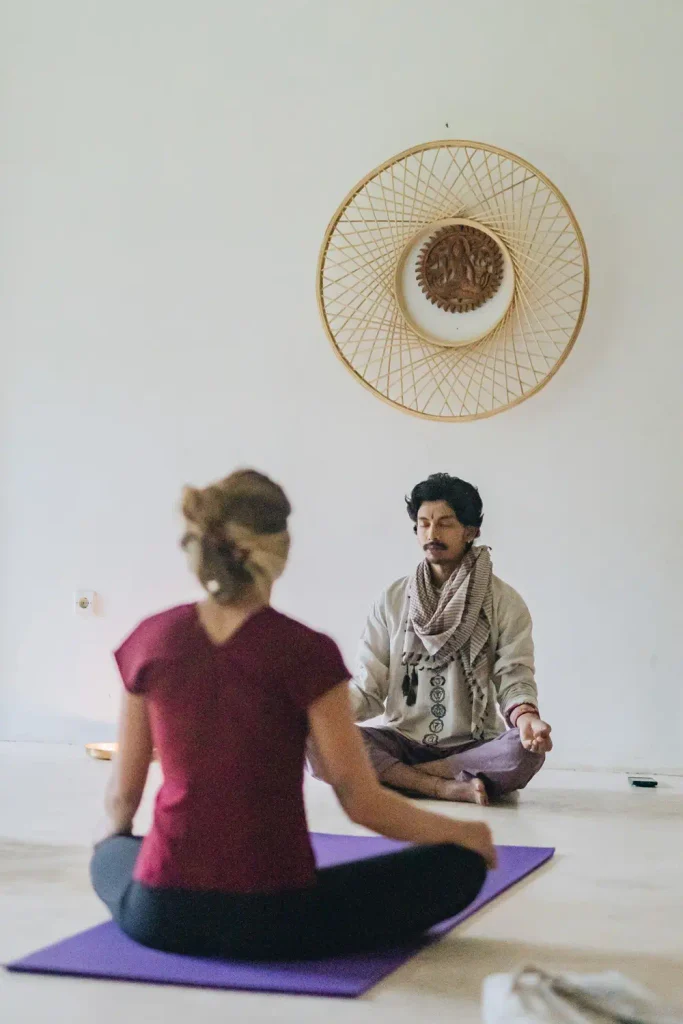
A body scan is a good place to start: lying down, you slowly move your attention through each part of the body, noticing how it feels without trying to change anything. This builds body awareness and is often easier for an anxious mind than trying to “clear your thoughts,” which rarely works and can add more pressure.
Yoga Nidra, sometimes called yogic sleep, is a guided practice you do lying down, where you stay awake but deeply relaxed. It suits people who find it hard to sit still and meditate, since there is a voice to follow instead of an instruction to sit in silence.
Mindful movement simply means paying full attention to each stretch or breath during your practice instead of letting your mind wander. This turns an ordinary session into something close to moving meditation. It needs no special skill, just a choice to notice what is actually happening in your body as you move.
How to Practice Yoga for Anxiety Safely
Skip anything that raises your heart rate if you already feel wired, including fast flows, deep backbends, or long breath holds. Keep the room quiet and skip loud or stimulating music if you are using yoga specifically for anxiety relief rather than fitness.
If a pose or breathing pattern leaves you feeling more anxious, breathless, or lightheaded, stop and go back to breathing normally. This is not a failure. Some techniques suit some people better than others, and you never have to push through discomfort in a practice that is meant to reduce it.
If you are new to yoga, a beginner class or a few sessions with a qualified teacher can help you learn safe alignment, especially for poses that involve the neck or lower back, before you practise alone regularly.
Building a Realistic Weekly Practice for Stress Management
Using yoga for stress management works best as a habit, not something you reach for only during a bad week. A realistic start is three to four short sessions a week, ten to twenty minutes each, mixing grounding poses with breathing practice. On demanding days, try a short session in the morning and a calming one in the evening, instead of saving your only practice for the weekend.
If you want a deeper foundation, stepping away from your daily routine for a planned program, such as a yoga retreat in Bali, can give you the time and guidance to build habits that are hard to form in small pieces at home. Bali Yoga Retreats works with people at exactly this stage, offering time to practise consistently with proper instruction, rather than trying to put together a routine from videos alone.
When to Seek Professional Support
Yoga has limits, and it is worth knowing them. Get support from a doctor, therapist, or mental health professional if anxiety is affecting your work, sleep, eating, or relationships; if you are having panic attacks; if racing thoughts do not ease with rest and self-care; or if yoga is the only tool you are using for a condition that has not been properly checked by a professional. None of this means yoga is not worth doing. It means treating it as one part of a fuller plan for your mental health, alongside proper support when you need it.
Frequently Asked Questions
Can yoga actually help with anxiety?
It can. Yoga eases physical symptoms like muscle tension and shallow breathing, and the breathing and mindfulness side of it supports a calmer state of mind. Think of it as something that works alongside professional care, not a treatment for a diagnosed anxiety disorder by itself.
What is the best yoga pose for anxiety?
There’s no single winner, but Legs-Up-The-Wall and Child’s Pose come up again and again. Both are easy to hold, need zero strength, and naturally slow the breath down.
How often should I practice yoga for stress relief?
Three or four short sessions a week beats one long one. Showing up often matters more than how long each session runs.
Can breathing exercises alone reduce anxiety without the poses?
Yes, to a real extent. Extended exhale breathing and box breathing both affect the nervous system directly, so they work fine on their own if you’re short on time.
Is yoga safe for panic attacks?
Gentle, grounding poses and slow breathing help some people get through or come down from a panic attack. That said, it’s not a substitute for a proper treatment plan if attacks are frequent or severe.
Should beginners with anxiety start with a class or practice alone?
A few beginner classes are worth it just to learn safe alignment. After that, plenty of people are perfectly comfortable doing simple, gentle sequences on their own at home.
How long does it take for yoga to help with stress?
Some people feel less physical tension after one session, especially with breathing work. Bigger shifts in your day-to-day stress usually need a few weeks of consistent practice.
This article is for general information and is not medical advice. If you have a respiratory or heart condition, are pregnant, or are unsure whether these practices suit you, please speak to your doctor before beginning.

 Call Us