


Why Australian Students Are Choosing Bali for Yoga Teacher Training
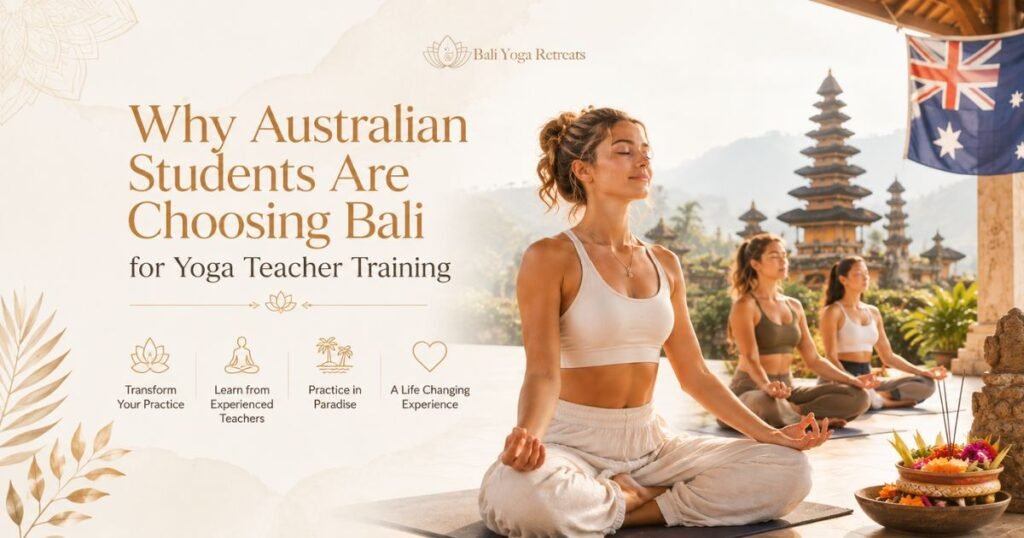
Table of Contents
- Why Australian Students Actually Choose Bali
- Australia to Bali: What the Trip Actually Looks Like
- What Yoga in Bali Actually Involves
- Yoga Teacher Training in Bali for Australian Students
- Yoga Course in Bali vs Yoga Teacher Training
- Yoga Retreat in Bali: The Shorter Option
- Do Australian Tourists Go to Bali Just for Yoga?
- What to Check Before Booking a Yoga Program
- Bali From Australia: Practical Notes Before Travelling
- Is Bali Suitable for First-Time Yoga Students?
- The Bottom Line
- Frequently Asked Questions
- Is Bali good for yoga teacher training?
- Why do Australian students choose Bali for yoga teacher training?
- How long is yoga teacher training in Bali?
- Is yoga teacher training in Bali suitable for beginners?
- How much does yoga teacher training in Bali cost?
- What should Australian students pack for a yoga course in Bali?
- Is Bali better for a yoga retreat or teacher training?
Search for “yoga teacher training Bali” from Australia, and you will find plenty of beautiful studios, tropical settings, and glowing testimonials. What is harder to find is a clear explanation of why so many Australian students choose Bali in the first place, especially when India, Thailand, and Sri Lanka also have established yoga traditions.
The answer is not simply Bali’s beaches or tropical atmosphere. For many Australians, the appeal comes from a combination of close proximity to Australia, relatively easy travel, an established yoga and wellness community, English-friendly training environments, and a wide range of yoga teacher training programs.
For students considering yoga teacher training in Bali, these practical factors can make Bali an attractive option. But choosing a destination is only the first step. The quality of the school, course structure, accreditation, teaching experience, and overall program should also be carefully considered.
This article looks at why Australian students are choosing Bali for yoga teacher training, what they can expect from a yoga program, and what they should check before booking.
Why Australian Students Actually Choose Bali
Distance gets mentioned first in most articles on this topic. It’s real, but it’s also not the whole story, and it’s probably not even the biggest part of it.
Australia is already Bali’s biggest source of foreign visitors. According to Bali’s provincial statistics agency (BPS Bali), Australian tourists made up 21.34 percent of foreign arrivals to the island in August 2025, the largest single-country share, and it was not a one-off month either. Practically, that means most Australians booking a yoga course aren’t landing somewhere unfamiliar. They’ve probably already been, or they know someone who has.
That familiarity changes the decision-making. A first-time yoga teacher training is already an experience: a new country, a new schedule, physically demanding days. Doing it somewhere already recognisable removes one layer of uncertainty that a first trip to, say, rural India or Sri Lanka doesn’t.
Cost is the second big factor, and it’s a real one. Expat cost-of-living guides consistently show day-to-day expenses in Bali—food, accommodation, and local transport—running lower than in Australian capital cities. Course fees themselves vary a lot by school, so this isn’t a claim that training is cheap. It’s that the surrounding costs, the weeks around the course, stretch a fixed budget further than they would at home.
Ubud’s wellness scene isn’t a recent trend — it’s been building for close to twenty years. Tourism researchers have tracked its shift from a quieter arts town into an international yoga and wellness hub through the 2000s and 2010s. That history shows up in practical ways: mature vegetarian and vegan food scenes; English-speaking practitioners; and studios staffed by teachers who’ve been doing this for a decade or more, not six months.
Timing helps too. Bali’s dry season runs roughly April through October, which lines up with winter across southern Australia. For someone in Melbourne or Hobart trying to avoid a cold July, that can make a real difference.
Then there’s the practical layer underneath all of it: direct flights, English-language instruction at most schools, and a genuinely wide range of course formats, from a single drop-in class to a full 200-hour certification. No single factor explains the pattern on its own. Together, they do.
Worth saying plainly: this isn’t a claim that Bali is objectively the best option. India, Thailand, and Sri Lanka all run well-regarded programs, and for students wanting more traditional, philosophy-heavy training, one of those may actually fit better. Bali’s advantage is fewer unknowns, not automatic superiority.
Read More: Best Time to Visit Bali: Weather, Crowds & Monthly Breakdown
Australia to Bali: What the Trip Actually Looks Like
Flight time depends heavily on the departure city. Perth has it easiest, around four hours direct, closer to a domestic flight than an international one. From the eastern capitals it’s longer: Sydney, Melbourne, and Brisbane all sit around six to six and a half hours direct into Denpasar, flown by Qantas, Jetstar, Virgin Australia, and Garuda Indonesia.
Time zones barely register. Bali runs on Indonesia Central Time, generally one to three hours behind various Australian states depending on daylight saving, nothing close to the jet lag of a European or US training.
Entry requirements are the part worth double-checking, not assuming. Australians currently need a visa to enter Indonesia, either an e-Visa on Arrival applied for online before departure or a Visa on Arrival processed at the airport. As it stands:
- The visa carries a fee
- It allows a stay of up to 30 days
- It can typically be extended once, for another 30 days, through an immigration office in Bali
These rules shift periodically. Anyone booking a training that runs close to that 30-day mark should confirm current requirements directly through Indonesia’s immigration authority or Smart Traveller, rather than trusting a blog post—including this one.
What Yoga in Bali Actually Involves
There’s no single “Bali yoga experience.” That’s worth clearing up early, because the marketing photos suggest otherwise.
Group classes are everywhere across Ubud and Canggu, ranging from casual drop-ins to structured multi-week programs. Most schools weave meditation and pranayama (breathwork) in alongside physical postures; this isn’t purely a fitness offering. Because Bali draws practitioners from dozens of countries, classes tend to be genuinely international rather than shaped by one teaching lineage. That cuts both ways: enriching for some, less consistent for others.
Experience levels vary just as widely. Some students arrive with years of home practice. Others are trying yoga seriously for the first time, drawn specifically by beginner-friendly course options. Philosophy and ethics tend to be where teacher training diverges most clearly from a casual retreat or drop-in class, a distinction worth understanding before choosing between them.
Yoga Teacher Training in Bali for Australian Students
This is the section that deserves the most research, since it’s the biggest commitment on offer, in time, money, and physical effort.
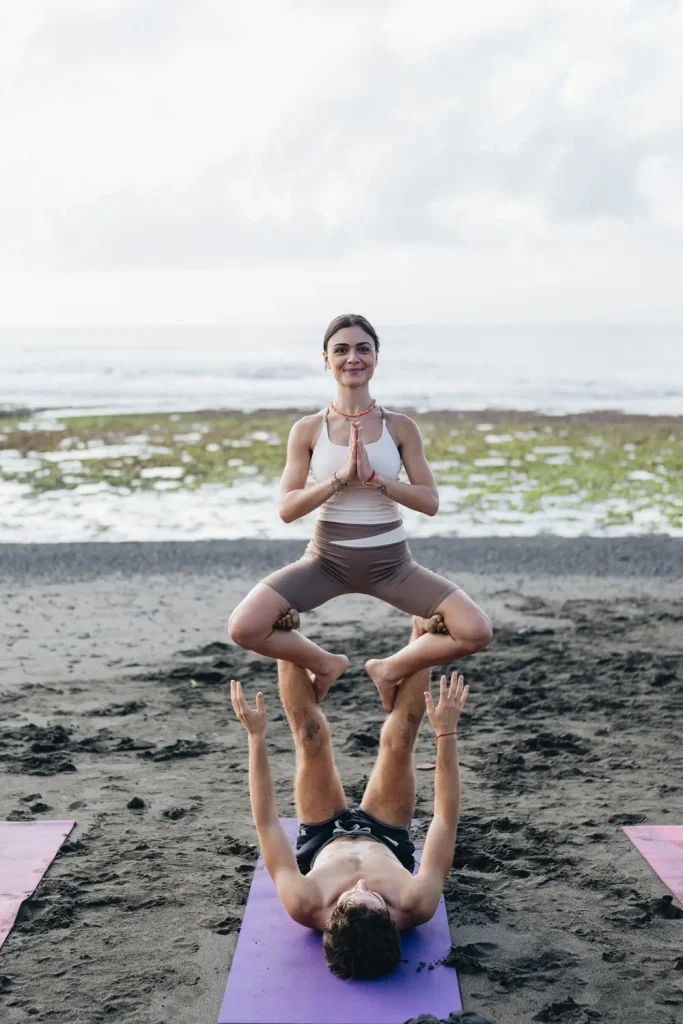
A standard 200 Hour Yoga Teacher Training in Bali generally runs three to four weeks full-time, though part-time formats spread over longer stretches exist too. Programs registered with a body such as Yoga Alliance are usually built around five core areas:
| Curriculum Area | What It Covers |
| Techniques and practice | Asana, alignment, and physical practice across styles |
| Teaching methodology | Class planning, cueing, group management |
| Anatomy and physiology | How the body moves, and how yoga interacts with it |
| Philosophy, lifestyle, ethics | The historical and philosophical foundations of practice |
| Practicum | Supervised teaching practice with instructor feedback |
A program may look great online, but there are a few things worth checking before you enroll:
- Whether the school is registered with a recognised credentialing body, and what that actually guarantees
- The teaching experience of the lead instructors specifically, not the school’s general reputation
- A detailed, hour-by-hour syllabus, not a vague outline
- Class size (smaller groups usually mean more individual feedback)
- What’s actually included in the fee versus what costs extra
- Independent reviews on platforms outside the school’s own site
Cost for a 200-hour program in Bali varies by accommodation standard and school reputation, generally landing somewhere between roughly USD 1,500 and USD 3,500. Prices can change often, so it’s better to get a current, detailed quote directly from the school than rely on figures published in an article.
Yoga Course in Bali vs Yoga Teacher Training
These two terms get used almost interchangeably online, which causes genuine confusion when comparing options side by side.
| Yoga Course in Bali | Yoga Teacher Training |
| Focused mainly on personal practice | Combines practice with teaching skills |
| A single class up to a one- or two-week program | Typically an intensive 200-hour (or longer) program |
| Suited to improving practice, or trying yoga for the first time | Suited to those considering teaching, or wanting deeper study |
| Certification, if any, varies and may not be accredited | Usually follows a curriculum tied to a recognised body |
Not every program in Bali fits this table exactly. Worth confirming what a specific course actually includes, rather than assuming based on the title alone.
Yoga Retreat in Bali: The Shorter Option
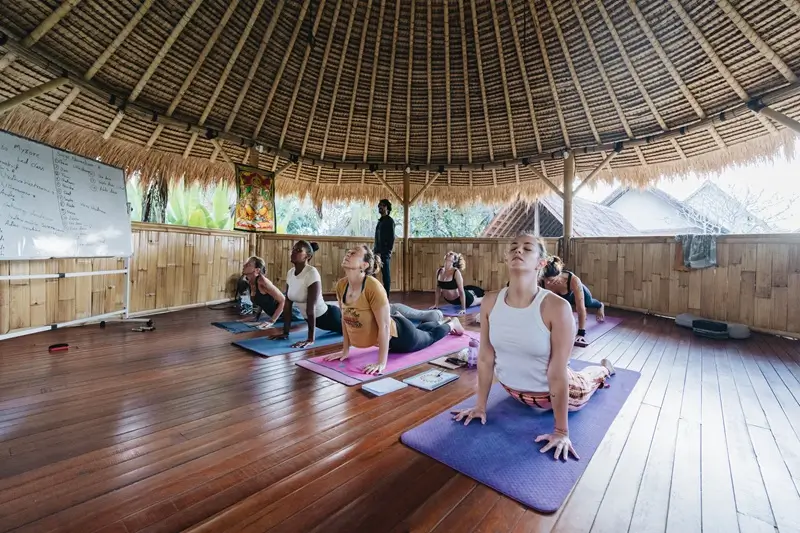
Not everyone wants a certification. For plenty of Australians, a yoga retreat in Bali, typically a few days to two weeks, fits better than a month-long training, mainly because it drops the assessment and teaching-practice load in favour of daily practice, meditation, and rest.
The appeal is fairly simple:
- Fits inside standard annual leave
- Costs considerably less than a full certification
- Requires no prior interest in teaching
- It’s a good way to try Bali first before committing to something longer
Some students use a short retreat first, then decide whether a 200-hour program is worth the bigger commitment later. That’s a reasonable sequence, not something to rush.
Do Australian Tourists Go to Bali Just for Yoga?
Given Australians already make up the largest single group of foreign visitors to Bali, it’s tempting to assume most are there for yoga. They’re not. Most are visiting for standard holiday reasons, and yoga tends to be one piece folded into a broader trip rather than the reason flights got booked in the first place.
What has changed is how often that piece shows up. A yoga class, a spa afternoon, a short retreat stay—these have become fairly normal add-ons to a Bali holiday, part of a wider shift toward wellness travel across the tourism industry generally, not something unique to Australian visitors specifically.
What to Check Before Booking a Yoga Program
A short list, worth going through properly before paying any deposit:
- Certification and accreditation status, and what it actually covers
- A detailed syllabus, not a general description
- Lead instructor qualifications and experience
- Daily schedule, start/end dates, and rest days
- What’s included in accommodation and food
- Proximity to shops, transport, and accommodation
- Independent reviews, not just site testimonials
- Refund and cancellation terms
- Extra costs — transfers, excursions, materials
- Group size and the language classes are taught in
- Any medical or fitness considerations worth flagging early
- Current visa requirements for the length of stay
- Travel insurance that covers physically intensive training
Bali From Australia: Practical Notes Before Travelling
A few things specific to this kind of trip, rather than Bali travel generally. Book flights with a buffer on either side of the course dates; an intensive schedule leaves little room to recover from a delayed connection. Arrange travel insurance separately from anything bundled into the course fee. The rupiah is the local currency; cards work fine in tourist areas, but small cash still helps for local transport. Internet in Ubud and Canggu is generally reliable. And a bit of cultural awareness—modest dress at temples and basic respect around ceremonies—is worth reading up on beforehand, since religious practice is visibly part of daily life across the island.
Is Bali Suitable for First-Time Yoga Students?
Depends far more on the program than on Bali as a place. A gentle, beginner-oriented retreat is generally fine for someone new to yoga. An intensive 200-hour training with multiple daily sessions is a different proposition and can be demanding even for students with some existing practice.
What actually determines suitability: the program’s stated experience level, how much individual support teachers offer, the intensity of the daily schedule, and whether expectations match reality. Not every beginner is ready to jump straight into an intensive training; building a home practice first, or choosing a program built for beginners, is usually the more realistic route in.
Read More: Bali Travel Guide for First-Time Yoga Students: Everything to Know Before You Go
The Bottom Line
Bali isn’t the automatic right choice for every student. But it’s not a random one either. Short flights, a destination Australians already know well, lower everyday costs, and a wellness scene that’s had years to grow, these are the real reasons Australian students keep choosing it, not just short flights.
Providers such as Bali Yoga Retreats are among the schools in Ubud that share a full 200-hour syllabus online. It’s worth reading that syllabus closely, whichever school ends up getting picked.
Before booking anything, the advice stays simple: check the certification, ask for the full course plan, look into the teachers’ experience, and confirm the latest visa rules from an official source, not from an article.
Frequently Asked Questions
Is Bali good for yoga teacher training?
Bali has a wide range of schools offering 200-hour and longer training programs, many registered with recognised credentialing bodies. Whether a specific program is worthwhile comes down to curriculum, instructor experience, and independent reviews, details that need checking school by school.
Why do Australian students choose Bali for yoga teacher training?
Beyond flight times, Australia is officially Bali’s largest source of foreign tourists, so most Australians already have some familiarity with the destination. Add generally lower living costs and a wellness industry with nearly two decades of history, and distance stops being the main explanation.
How long is yoga teacher training in Bali?
A standard 200-hour program typically runs three to four weeks full-time. Part-time formats spread over longer periods exist, along with 300-hour or 500-hour advanced trainings for those already certified.
Is yoga teacher training in Bali suitable for beginners?
Depends on the individual program, not the location. Some trainings build in extra support for newer students; others assume a regular existing practice. Checking a program’s stated experience requirements before enrolling avoids a mismatch later.
How much does yoga teacher training in Bali cost?
Costs vary by school, accommodation, and inclusions, generally between roughly USD 1,500 and USD 3,500 for a 200-hour program. Pricing shifts, so a current quote from the school itself beats any published estimate.
What should Australian students pack for a yoga course in Bali?
Lightweight, breathable clothing, sun protection, a reusable water bottle, and something modest for temple visits. Many schools supply mats and props, which is worth confirming in advance rather than over-packing gear that’s already provided.
Is Bali better for a yoga retreat or teacher training?
Neither is automatically better. A retreat suits a shorter, rest-focused break; teacher training suits someone after a structured qualification with a genuine interest in eventually teaching.
This article is for general information and is not medical advice. If you have a respiratory or heart condition, are pregnant, or are unsure whether these practices suit you, please speak to your doctor before beginning.


 Call Us